
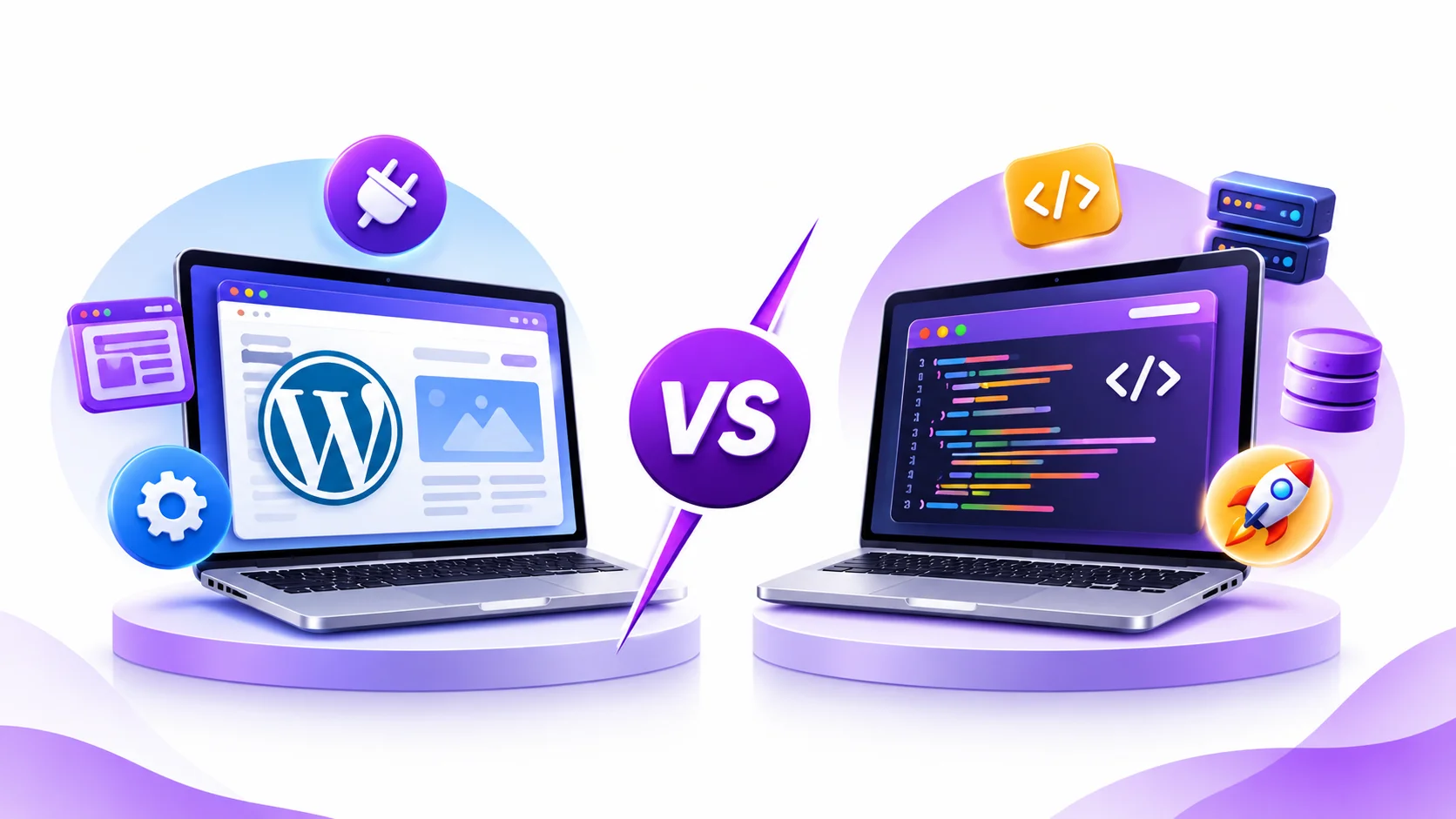
WordPress vs Custom Website: Which Is Better for Pakistani Businesses in 2026?
Two quotes land in your inbox in the same week. One agency wants PKR 1.5 million for a custom-built site. A freelancer down the road says he’ll do it on WordPress for a fraction of that, live in two weeks.
Both sound sure of themselves. So who’s wrong?
Neither, probably. And that’s what makes this so confusing.
People argue about WordPress vs custom website the way uncles argue about the cricket team selection. Everyone has a side. Nobody wants to hear “it depends.” But if you run an actual business here, with an actual budget, you don’t need a side. You need the option that fits your business today. Not the one your pitch deck dreams about.
The Short Answer (and Why It Depends)
WordPress is basically a ready-made engine. You pick a theme for the look, add plugins for features, and edit pages yourself from a dashboard. Want to change the phone number on your contact page? Two minutes. No developer needed. Roughly two in every five websites on the internet run on it, so it’s clearly doing something right.
Custom website development is the other road. A developer builds your site from zero, usually with Laravel, Node.js, Django or React. Nothing is borrowed. Every button is there because someone sat down and decided it should be.
So which one wins?
For most small and mid-sized businesses in Pakistan, I’d say eight out of ten, WordPress is the smarter place to start. Yes, it’s cheaper. But that’s not the main reason. Most businesses simply don’t know yet what their website really needs to do. Going custom before you know that is like getting a suit stitched while you’re still deciding whether to join a gym.
The other two out of ten? They really shouldn’t touch WordPress. We’ll get to them.

WordPress vs Custom Website: 7 Key Differences.
Here’s the side-by-side, minus the sales talk.
1. Upfront cost. WordPress is far cheaper to build. Custom starts high and climbs with every feature you add.
2. Time to launch. A WordPress business site can go live in two to four weeks. Custom builds often take months.
3. Day-to-day editing. On WordPress, your own staff can add pages and blog posts. On a custom site, even small edits usually mean messaging a developer and waiting.
4. Flexibility. Custom wins this one. If you can imagine it, a developer can build it. WordPress bends a long way, but plugins have limits.
5. SEO. WordPress gives you solid SEO tools out of the box, like Rank Math or Yoast and clean URLs. Custom sites can rank just as well, but only if the developer builds SEO in on purpose.
6. Security and updates. WordPress needs regular updates because it’s a popular target. Custom code gets attacked less often, but every bug is yours to find and pay for.
7. Scalability. For huge traffic, complex logins or heavy data, custom gives you more control. For a normal business site, WordPress scales fine.
Website Development Cost in Pakistan: Where the Money Actually Goes:
Everyone asks about price first. Fair enough. The truth is that website development cost in Pakistan is all over the place. If someone gives you a fixed number without asking a single question, they’re guessing.
Rough ballpark: a properly built WordPress business site from a decent team usually costs somewhere between PKR 50,000 and 250,000. Page count, design work and whether you need an online store push it up or down.
Custom is a different league. A simple custom site can run into several lakh. Add user accounts, dashboards or tricky logic, and you can cross a million without trying very hard. Rates also swing a lot between freelancers and agencies, and between Lahore, Karachi and Islamabad. Treat these numbers as a starting point, not a price list.
Here’s the part people miss. The build is rarely your biggest expense.
A WordPress site is cheap to launch and cheap to change. Your marketing person can put up a new landing page on a Tuesday afternoon. A custom site costs more to launch. After that, every small change, a new section or a form tweak, goes through a developer and an invoice. Over three years, that gap adds up quietly.
Then there’s the dark side of “affordable website development.” In Pakistan, a lot of cheap quotes mean a pirated theme, nulled plugins and zero updates. The site looks great on handover day. Six months later it’s hacked, usually right in the middle of your Eid sale.
Cheap and affordable aren’t the same thing. Paying a little more for a licensed theme and someone who actually maintains your site is almost always worth it.
Hosting matters too, and people forget about it. If your server sits in Europe or the US, a Lahore clinic’s site can feel slow for patients browsing on mobile data. Choose hosting that’s quick for Pakistani visitors, or put a CDN in front. Most of your traffic is on phones anyway, often on shaky 4G, so a heavy site hurts you more here than it would in London.
And then there’s maintenance. WordPress needs regular updates for the core, the theme and every plugin. Skip them and you’re leaving the door unlocked. The good news? WordPress development in Pakistan has grown up a lot, so a monthly care plan is cheap, often just a few thousand rupees. Custom sites have the same bill, usually bigger. Nobody in a global community is fixing bugs in your code for free. Your code, your problem.
When WordPress Wins, and When It’s Time to Go Custom:
Let’s start with WordPress, since that’s where most of you will land.
Run a clinic, law firm, school, restaurant, real estate agency or consultancy? Then your website has three jobs. Show up on Google. Look trustworthy. Get people to call or fill a form.
WordPress does all three really well. Blogs, local landing pages, schema, internal links, it’s all simple. If organic traffic matters to you, that’s a big plus. A good WordPress website development company can get you ranking-ready in weeks, not months.
Online stores need a bit more thought, but WooCommerce handles a lot. Cash on delivery, still huge in Pakistan, works fine. JazzCash, Easypaisa and local card gateways have plugins available. Urdu and right-to-left layouts are possible too, though I’d ask any developer to show you a live example before believing them.
Selling a few hundred products with nothing unusual? WooCommerce is usually enough. Shopify is worth a look as well, but Pakistani payment gateway support has always been its weak spot.
Now the custom side.
Custom website development earns its price when the website is the business. Think ride-booking apps. Multi-vendor marketplaces where hundreds of sellers manage their own stock. Booking systems with live availability and complicated pricing. Fintech tools. Internal portals for companies with odd workflows.
Here’s a simple warning sign. You explain what you need, and the developer keeps saying “we’ll need a plugin for that… and another plugin for that… and a third one to connect those two.” Stop right there. You’re forcing WordPress to be something it isn’t, and you’ll end up with a slow, fragile site nobody wants to maintain.
Scale is the other trigger. Expecting tens of thousands of users at once, or handling sensitive data under strict compliance rules? A purpose-built system gives you control over speed and security that a plugin-heavy setup can’t match.
One myth needs to go. Some developers say WordPress is “not professional.” That’s nonsense. Plenty of big global brands and news sites run on it. What matters is how well the site is built, not the name of the platform.
Same goes for speed. “WordPress is slow, custom is fast” is half true at best. A WordPress site with a light theme, good hosting and caching can load in under two seconds. A badly built custom portal can crawl because nobody bothered to compress images or fix database queries. The platform doesn’t decide speed. The people building it do.
I’ve noticed a pattern, too. Businesses that regret going custom usually did it too early. They spent most of their budget, launched, found out customers wanted something slightly different, and paid again for every change. The ones who regret WordPress usually stretched it way past its limits, or hired the cheapest person they could find.
Neither group picked the wrong tool. They picked it at the wrong time, or hired the wrong people.
Frequently Asked Questions
Is WordPress good enough for a professional business website in Pakistan?
Yes. For service businesses, clinics, schools, agencies and most small online stores, WordPress is more than enough. Quality depends on who builds it, not on the platform itself.
How much does a WordPress website cost in Pakistan in 2026?
A properly built WordPress business site usually costs around PKR 50,000 to 250,000. The final price depends on the number of pages, custom design work, and whether you need e-commerce.
When should I choose custom website development over WordPress?
Go custom when the website is your core product, like a marketplace, booking platform or fintech app. It also makes sense when you need heavy traffic handling, complex user roles or strict data security.
Can I move from WordPress to a custom website later?
Yes, and many startups do exactly that. Keep your content and customer data organized from day one, and moving later becomes much easier.
Is WordPress safe from hacking?
WordPress is safe when it’s kept updated, uses licensed themes and plugins, and sits on decent hosting. Most hacked sites in Pakistan are running nulled plugins or haven’t been updated in months.